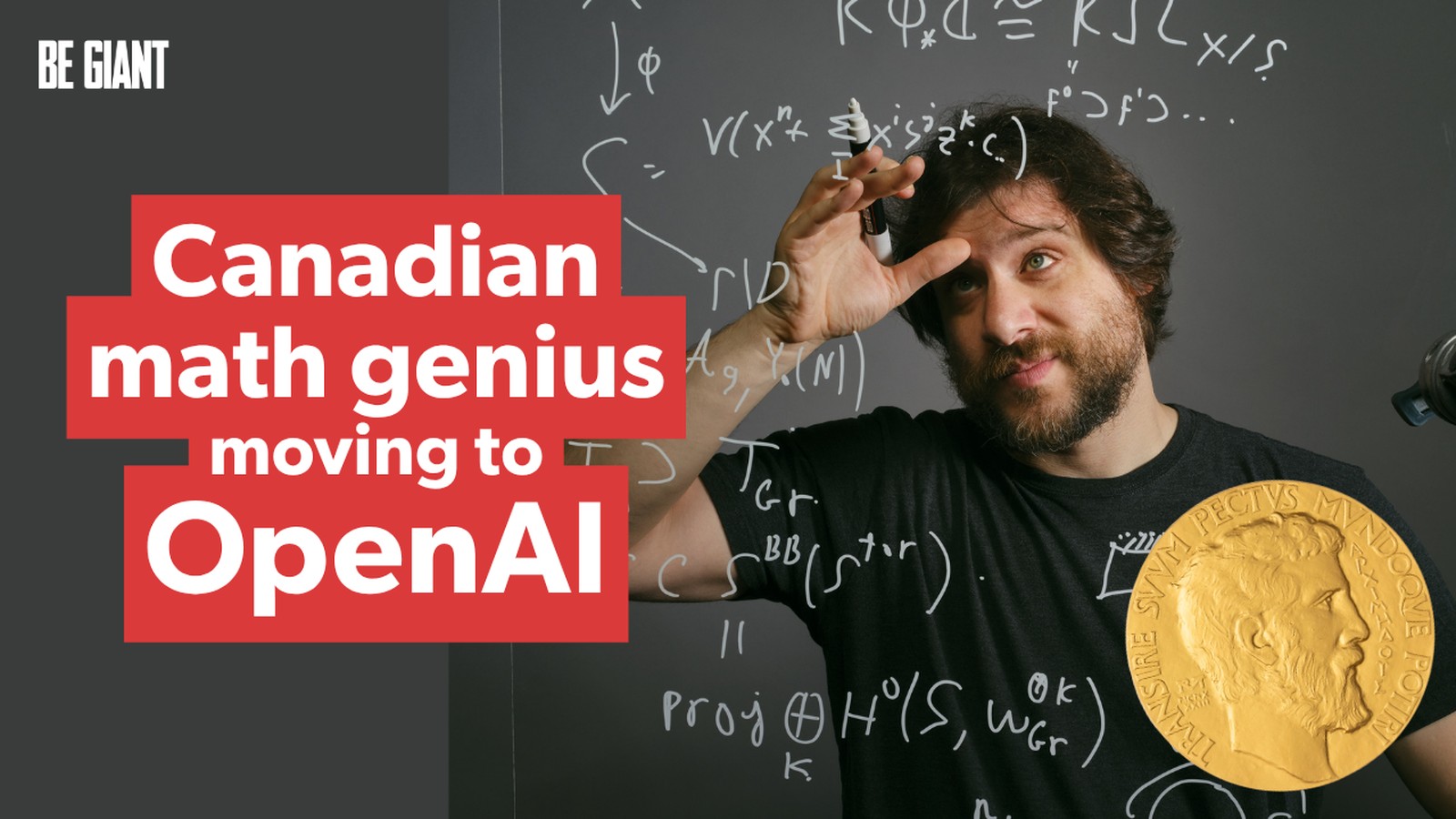
On July 23, 2026, Jacob Tsimerman was awarded the Fields Medal, mathematics' highest honor, at the International Congress of Mathematicians in Philadelphia, recognizing his foundational contributions to arithmetic geometry and his proof of the André-Oort conjecture. Hours after receiving the award, Tsimerman announced that he would take a leave of absence from his position as a professor at the University of Toronto to join OpenAI's safety division beginning in late August 2026. The move, reported by The Atlantic, Quanta Magazine, and multiple outlets, represents one of the most significant migrations of academic talent to a private AI laboratory in the industry's history, and it signals that the frontier of artificial intelligence safety is now attracting the same caliber of intellectual firepower that once defined pure mathematics. For personal injury law firms, Tsimerman's decision is a powerful indicator that the AI safety debate has moved from the margins of technology policy to the center of scientific inquiry, and that the capabilities of AI systems are advancing at a pace that even the world's most brilliant mathematicians believe requires urgent, direct intervention.
Tsimerman's motivation for joining OpenAI is explicitly rooted in his assessment of AI's trajectory. He has publicly stated his belief that AI systems will become 'superhuman' at doing mathematics, surpassing human researchers in both speed and quality, within a matter of years. In a 2025 co-authored report, Tsimerman established a taxonomy of existential risks associated with artificial intelligence, and he has argued that because AI development cannot be easily stopped, the most productive path is to engage directly with the technology to help shape its safety protocols from within a frontier lab. His expertise in 'o-minimality,' a field that finds hidden structures within complex mathematical objects, is viewed as highly relevant to developing rigorous mathematical guarantees for the behavior of long-horizon AI agents, the kind of autonomous systems that are increasingly capable of multi-step reasoning and real-world action.
The broader context of Tsimerman's move is a growing 'brain drain' from academia to industry AI labs, driven by a compute gap that gives private companies vastly superior computational resources, a research paradigm shift toward automated theorem proving and formal verification, and the lower administrative burdens of industry positions compared to tenure-track academic roles. Tsimerman's transition has been described by some observers as a 'requiem' for traditional academic mathematics, highlighting the increasing migration of top-tier talent from universities to private industry. While his departure is a loss for pure mathematics, his decision to focus on AI safety rather than pure research reflects a growing consensus among elite scientists that the risks of uncontrolled AI development may outweigh the benefits of continued theoretical advancement in other domains.
For personal injury law firm leadership, Tsimerman's move to OpenAI carries three layers of strategic significance. First, the fact that a Fields Medalist, a mathematician at the absolute pinnacle of human intellectual achievement, has concluded that AI safety is a more urgent problem than his own field of research is a powerful signal that the capabilities of AI systems are advancing faster than our collective ability to manage them safely. This perception, now held by the industry's most elite scientific talent, will increasingly influence judicial and regulatory attitudes toward AI liability, and courts may be more receptive to arguments that AI developers had a duty to slow down or implement more rigorous safety testing before deploying systems capable of autonomous harm. Second, Tsimerman's focus on mathematical guarantees for AI agent behavior, using techniques like o-minimality to find hidden structures in complex systems, suggests that the next generation of AI safety research will be far more rigorous and formal than the current reliance on empirical testing and red-teaming. PI firms that represent clients harmed by AI systems should be prepared to engage experts who can translate these formal safety frameworks into evidence of negligence, asking whether a developer applied the same mathematical rigor to safety verification that Tsimerman applies to number theory. Third, the migration of top academic talent to industry labs raises the stakes for corporate AI governance, because the companies that attract the best safety researchers will increasingly be the companies that set the de facto industry standards for AI safety. PI firms should monitor which AI vendors are investing in formal safety research, which are publishing their safety protocols, and which are transparent about their safety testing, because these practices will become the benchmarks against which negligence claims are measured. As the world's brightest mathematical minds redirect their attention from pure theory to AI safety, the legal profession must be prepared to hold AI developers accountable to the same standard of rigorous proof that Tsimerman demands in his own work.