
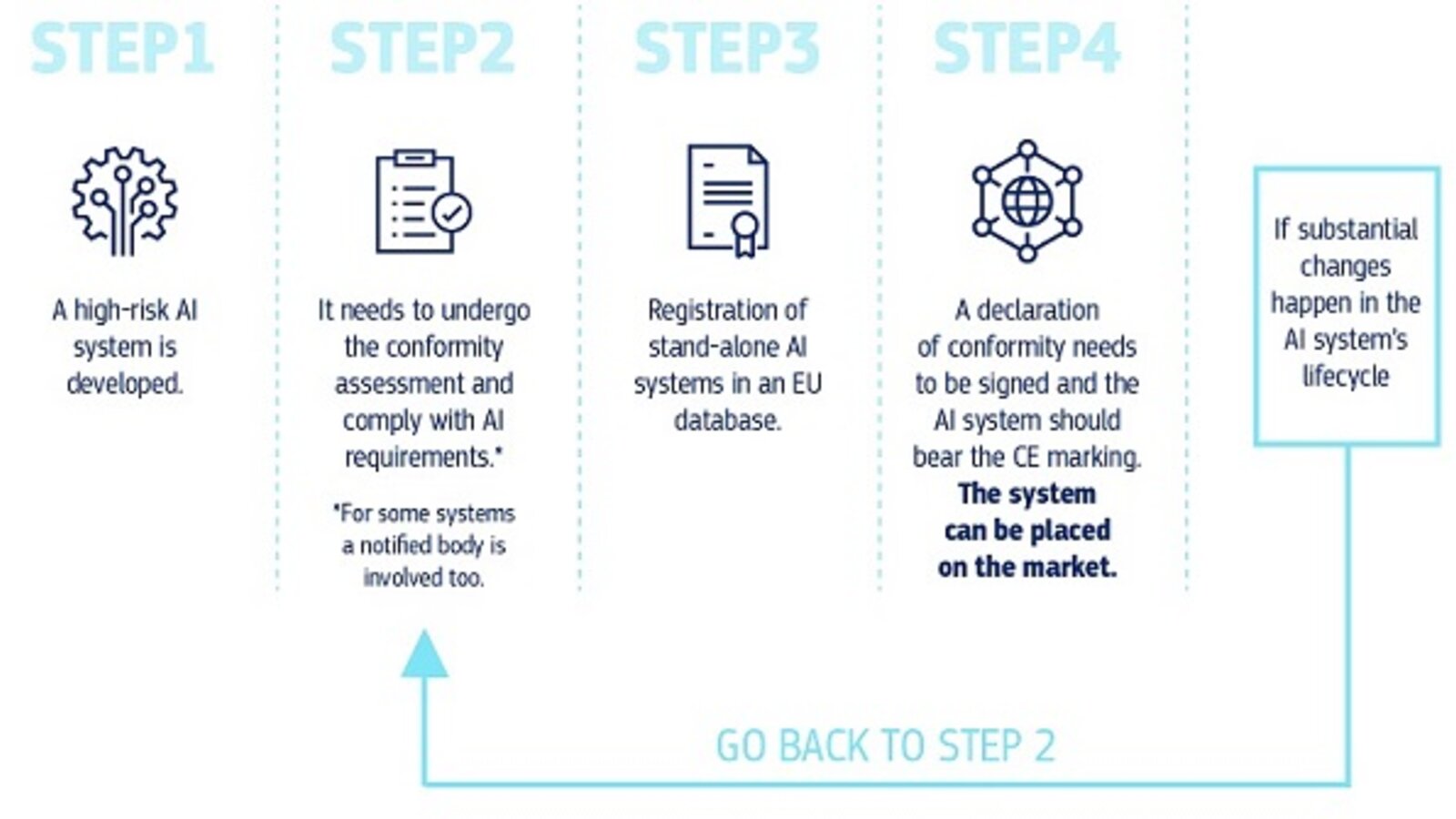
On August 2, 2026, the European Union's landmark Artificial Intelligence Act enters a decisive enforcement phase, activating mandatory transparency obligations under Article 50 that will require all AI providers and deployers whose content reaches EU users to clearly label AI-generated text, images, audio, and video. The rules, first enacted in 2024 but staggered across implementation phases, now impose real-time compliance duties with penalties of up to €15 million or 3% of global annual turnover, whichever is higher, for violations related to transparency and general-purpose AI governance. The European Commission's AI Office and national market surveillance authorities in each member state are now formally empowered to investigate, demand corrective measures, and levy fines, a regulatory framework that will immediately affect every major AI platform, including OpenAI, Google, Anthropic, and Meta, as well as any law firm or legal technology vendor whose AI-powered tools generate content consumed within the EU.
The transparency obligations cover four distinct domains that directly intersect with legal practice and personal injury law. First, any AI system that interacts directly with natural persons, including chatbots, voice assistants, and AI-generated customer service agents, must clearly disclose that the user is communicating with a machine rather than a human. Vague labels like 'assistant' or disclosures buried in terms of service are explicitly insufficient; the notice must be perceivable during the interaction itself. Second, providers of generative AI systems must ensure that all outputs, text, images, audio, and video, are marked in a machine-readable format that allows for automated detection of synthetic content. This requirement applies not only to standalone generative AI platforms but also to any embedded AI feature within a legal document automation tool, litigation support platform, or client-facing application that produces AI-generated content. Third, deployers must inform individuals when they are exposed to emotion recognition or biometric categorization technologies, a provision that is increasingly relevant as AI-powered intake systems, medical diagnostic tools, and surveillance systems become standard in personal injury practice. Fourth, deepfakes and AI-generated or manipulated text published to inform the public on matters of public interest must be clearly labeled, with a specific carve-out for content that has undergone human review or editorial control, provided a natural or legal person holds editorial responsibility.
The penalties are structured in tiers. For transparency and general-purpose AI violations, the maximum fine is €15 million or 3% of global annual turnover. For prohibited AI practices, such as social scoring or manipulative subliminal techniques, the penalty escalates to €35 million or 7% of global turnover. For providing incorrect information to authorities, the penalty is €7.5 million or 1.5% of global turnover. The Act applies extraterritorially, meaning any provider or deployer whose AI output is used in the EU is subject to these rules regardless of where the company is headquartered. This means that a U.S.-based personal injury law firm using an AI-generated demand letter or AI-drafted client intake form that is transmitted to a client in the EU could, in theory, trigger compliance obligations, and the law firm should verify whether its AI vendors have implemented the required labeling and transparency infrastructure.
For personal injury law firm leadership, the EU AI Act enforcement carries three practical implications. First, firms that use AI-powered tools for client-facing content, including intake chatbots, automated demand letters, settlement calculators, or AI-generated case summaries shared with clients, should immediately audit whether those tools comply with the EU transparency requirements, particularly if the firm serves international clients, cross-border personal injury cases, or clients who are EU residents. The machine-readable marking requirement means that AI-generated content must carry technical metadata, not just visual disclaimers, and firms should verify that their vendors have implemented this infrastructure. Second, the deepfake labeling provisions have immediate relevance to the types of AI-generated evidence that personal injury firms may encounter in litigation, including AI-generated medical imaging, synthetic video reconstructions of accidents, or manipulated audio recordings. The EU's requirement for clear labeling of synthetic content creates a precedent that U.S. courts may increasingly reference when assessing the admissibility and authenticity of AI-generated evidence in personal injury trials. Third, the penalty structure, which ties fines to global revenue rather than EU-specific revenue, means that even a small compliance failure affecting EU users could trigger a multi-million-euro liability for a global AI platform, and this enforcement risk will likely accelerate vendor investment in compliance infrastructure, which in turn should improve the transparency and auditability of AI tools that PI firms use. As the world's first comprehensive AI regulation enters its operational enforcement phase, the EU AI Act is setting the global standard for AI transparency, and personal injury law firms that operate at the intersection of technology, evidence, and client communication must understand how these rules affect their tools, their evidence, and their liability exposure.