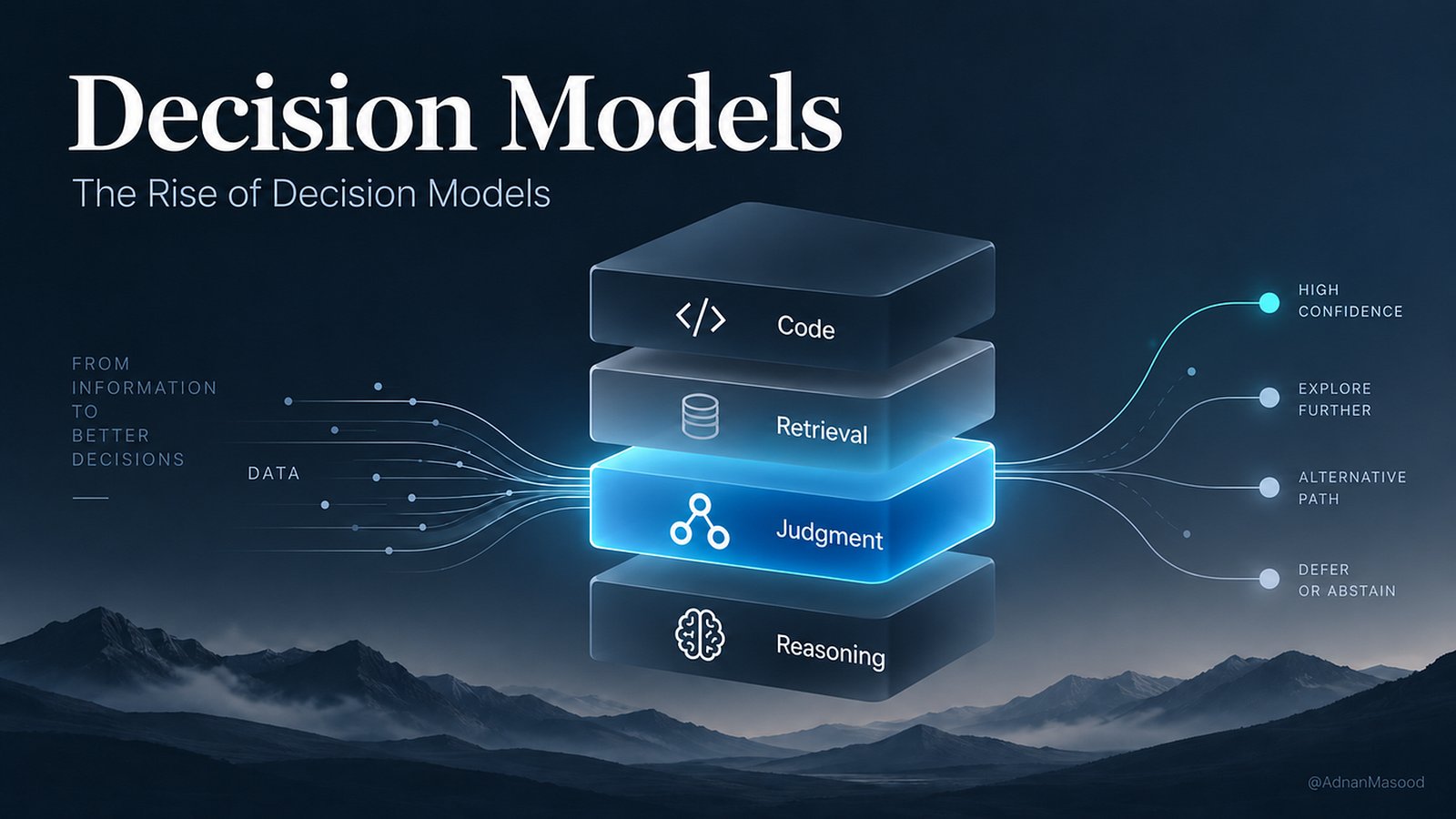
On October 1, 2026, Cloudflare unveiled Clef and Clef-flash, a new family of open-weight decision models designed to bring deterministic, structured reasoning to artificial intelligence agent workflows. The announcement, published on Cloudflare's official blog and reported by multiple technology outlets, represents a significant architectural departure from the large language models that currently dominate agentic AI systems. Rather than generating free-form text responses, Clef models accept a structured input state and a set of typed questions, then return calibrated probability distributions for predefined choices, enabling AI agents to make programmatic decisions without the latency, cost, and non-determinism of text generation. For personal injury law firms, the Clef release is significant because it introduces a new category of AI infrastructure that could fundamentally change how legal workflow automation is built, and because the model's emphasis on deterministic, auditable decision-making addresses one of the most persistent concerns that attorneys have about delegating legal tasks to AI systems.
The technical architecture of Clef is designed for speed and precision. Clef, the larger model, is based on a 27-billion-parameter Qwen backbone with a 64,000-token context window and vision encoder support, enabling it to process both text and images in a single decision pass. Clef-flash is a 9-billion-parameter variant optimized for latency, delivering median decision times of 38.8 milliseconds compared to 209.3 milliseconds for the full Clef model and 524.1 milliseconds for Jev, the competing decision model from Typesafe AI. Both models are hosted on Cloudflare's Workers AI platform, which distributes inference across edge data centers to minimize network latency, and the model weights are available on Hugging Face under an Apache 2.0 license for self-hosting. For PI firms, these performance characteristics are relevant because they demonstrate that AI-assisted decision-making can now operate at speeds that match or exceed human reaction times, opening the door to real-time automation of legal workflows that previously required attorney review at every decision point.
The decision-model paradigm that Clef represents is particularly well-suited to legal applications because it produces structured, typed outputs rather than free-form text. In a typical legal workflow, an AI system might need to classify an incoming document as a complaint, answer, motion, or discovery request; route it to the appropriate attorney based on matter type and urgency; flag it for expedited review if it contains a statute of limitations issue; and prioritize it within the assigned attorney's queue. A traditional large language model would generate a text response describing these classifications, which would then need to be parsed, validated, and converted into actionable system commands. Clef, by contrast, returns a structured probability distribution for each classification dimension directly, eliminating the text-generation step and the parsing ambiguity that comes with it. For PI firms, this means that automated intake triage, document classification, and workflow routing can be built on a foundation of deterministic outputs that are auditable, testable, and less prone to the hallucination errors that have made attorneys wary of delegating classification tasks to generative AI.
Cloudflare's benchmark results illustrate the model's competitive position. On the Jev Decision Index, which measures accuracy across multiple classification benchmarks, Clef outperformed Jev in three of four workflow categories: invoice processing, customer service, and security incident classification. On the broader BFCL benchmark for function-calling exactness, Clef scored 98.47% and Clef-flash scored 98.76%, both substantially above Jev's 95.75%. The models also demonstrated strong performance on the API-Bank accuracy benchmark, with Clef-flash achieving 93.11% and Clef achieving 91.93%, compared to Jev's 88.19%. For PI firms evaluating AI tools, these benchmarks provide a quantitative basis for comparing decision-model performance, but they also highlight the importance of domain-specific evaluation: a model that excels at general classification may still require fine-tuning on legal document types, medical terminology, and jurisdiction-specific procedural rules before it can be deployed in a PI practice with confidence.
For personal injury law firm leadership, the Cloudflare Clef release carries three practical implications. First, the open-weight licensing under Apache 2.0 means that PI firms can download, customize, and self-host the models without ongoing API fees or vendor dependency, and firms with technical capacity should evaluate whether self-hosting a decision model for intake classification, document routing, or case prioritization could reduce costs and increase control compared to proprietary SaaS solutions. Second, the model's deterministic output architecture addresses a key concern about AI in legal practice by producing structured, probability-calibrated decisions rather than free-form text, and PI firms should prioritize workflow automation tools that use similar structured-output designs because they are more auditable, less prone to hallucination, and easier to integrate with existing practice management systems. Third, Cloudflare's reinforcement learning fine-tuning service for Clef enables organizations to train domain-specific variants using their own labeled data, and PI firms with substantial case history should consider whether their accumulated intake records, settlement outcomes, and judicial decision data could be used to fine-tune a decision model that predicts case value, identifies high-risk matters, or optimizes resource allocation based on the firm's own historical patterns. As Cloudflare open-sources a new class of decision models optimized for agentic workflows, the Clef release is a reminder that the infrastructure for legal AI automation is evolving rapidly, and personal injury firms that understand and adopt these architectural advances will be better positioned to build scalable, auditable, and cost-effective technology systems.