
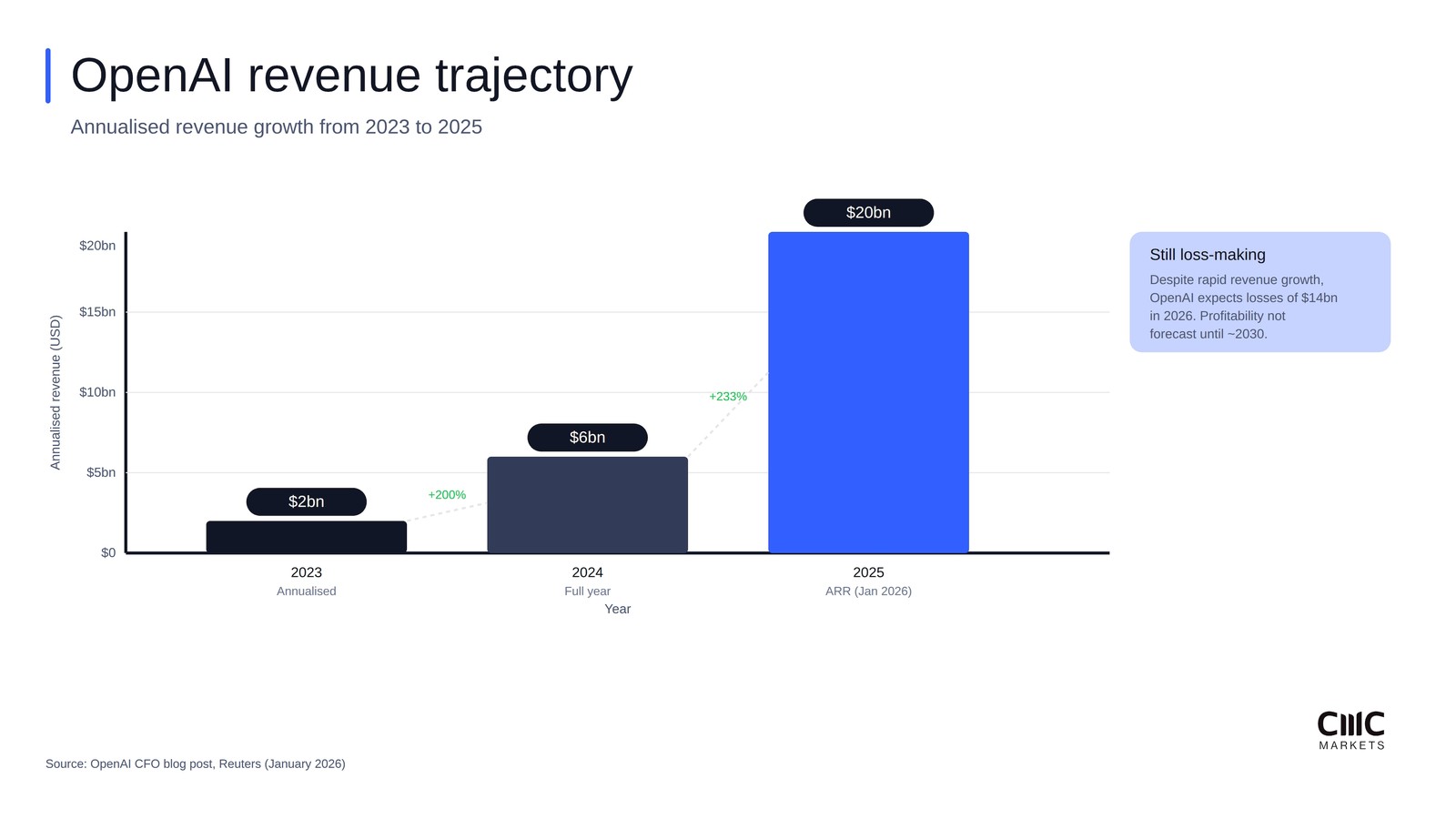
On September 29, 2026, multiple financial outlets including Bloomberg, Axios, and Quartz reported that OpenAI's annualized revenue run rate had reached nearly $70 billion, a figure that represents more than 70% growth since the beginning of the third quarter of 2026 and places the company among the fastest-growing technology businesses in history. The acceleration, first disclosed by Axios and subsequently confirmed by Bloomberg, is driven by two converging factors: enterprise adoption that has more than doubled since July, and consumer revenue in Q3 2026 alone that exceeded the company's total revenue for the entire year of 2025. For personal injury law firms, the scale of OpenAI's commercial penetration is significant not merely as a business metric but as a measure of how deeply AI tools have embedded themselves into corporate workflows, consumer interactions, and institutional decision-making, because the number of potential plaintiffs who have been affected by AI systems, and the number of corporate defendants who have deployed them, both scale directly with the revenue figures that OpenAI is now reporting.
The enterprise growth trajectory is particularly relevant to litigation risk assessment. OpenAI's business-to-business sales, which include API access for software developers, ChatGPT Enterprise subscriptions for corporate teams, and API integrations for legal technology vendors, have more than doubled in the approximately sixty days between July and September 2026. This implies that millions of additional corporate users, including employees at law firms, insurance companies, healthcare providers, and government agencies, now have access to OpenAI's most capable models for tasks ranging from document drafting and data analysis to customer service and claims processing. Corporate integration of AI coding tools, particularly Codex and related developer products, has been identified as a primary driver of this growth. For PI firms, the rapid expansion of enterprise deployment means that the pool of potential defendants in AI-related litigation is growing at a pace that may outstrip the legal system's ability to develop consistent precedents, and that discovery in cases involving AI-generated documents, automated decisions, or model-assisted analysis will increasingly require expertise in enterprise AI procurement, deployment, and governance.
The consumer revenue figures are equally striking and carry distinct liability implications. OpenAI generated more revenue from consumer adoption in Q3 2026 than it did throughout all of 2025, a comparison that illustrates both the dramatic increase in individual user engagement and the growing monetization of personal AI interactions through ChatGPT Plus, ChatGPT Pro, and newer agentic products like the Dots interface. With hundreds of millions of individual users worldwide, OpenAI's consumer-facing products are now a mass-market technology with the same scale of distribution as major social media platforms, search engines, and mobile operating systems. This scale transforms the liability calculus: even a rare failure mode, such as a model hallucination that provides incorrect medical advice, a deceptive output that induces a harmful financial decision, or an autonomous agent action that damages a user's digital identity, can affect thousands or millions of users simultaneously, creating the potential for class-action litigation with aggregate damages that rival the largest product liability and consumer protection cases in history.
The financial context surrounding the $70 billion run rate also shapes how courts and juries may perceive OpenAI's capacity to invest in safety. The company reported a net loss of $38.5 billion in 2025, driven by the extraordinary costs of training frontier models and maintaining inference infrastructure at global scale. OpenAI has indicated it will not pursue an initial public offering in 2026, citing a desire to focus on technology safety and platform stability, but the company is reportedly engaged in discussions to raise $30 billion in a funding round that would value it at approximately $1.4 trillion. For PI firms, these numbers are relevant to punitive damages analysis, because they establish that OpenAI has access to capital resources that are orders of magnitude larger than the safety investments it has publicly disclosed, and because they undermine any defense argument that the company could not afford to implement more rigorous testing, monitoring, or human oversight infrastructure. The fact that a company valued in the trillions of dollars is reporting a $38.5 billion annual loss while simultaneously expanding deployment at a pace that generates $70 billion in revenue suggests that commercial priorities are driving resource allocation decisions that may be disproportionate to safety expenditures.
For personal injury law firm leadership, the OpenAI revenue milestone carries three practical implications. First, the scale of enterprise and consumer adoption means that AI-related claims will increasingly involve OpenAI products as either the primary technology at issue or a component of a larger system, and PI firms should develop technical familiarity with OpenAI's model families, API capabilities, and enterprise governance features so that they can effectively depose technical witnesses, draft discovery requests, and evaluate expert testimony in cases involving these systems. Second, the rapid revenue growth relative to publicly disclosed safety spending creates a basis for arguing that OpenAI has prioritized market expansion over risk mitigation, and PI firms should monitor the company's safety disclosures, transparency reports, and internal safety team communications as potential evidence that commercial pressure compromised safety judgment in specific deployment decisions. Third, the company's decision to remain private in 2026 while pursuing massive private funding rounds means that traditional securities litigation tools will not be available to plaintiffs, and PI firms should be prepared to build cases through tort, consumer protection, and products liability theories rather than relying on securities fraud or shareholder derivative actions that require a public company defendant. As OpenAI's revenue run rate approaches $70 billion and its valuation enters the trillion-dollar range, the financial scale of the company underscores the equally massive scale of the liability exposure it has created by deploying AI systems to hundreds of millions of users with safety frameworks that the industry's own researchers have acknowledged are insufficient.