
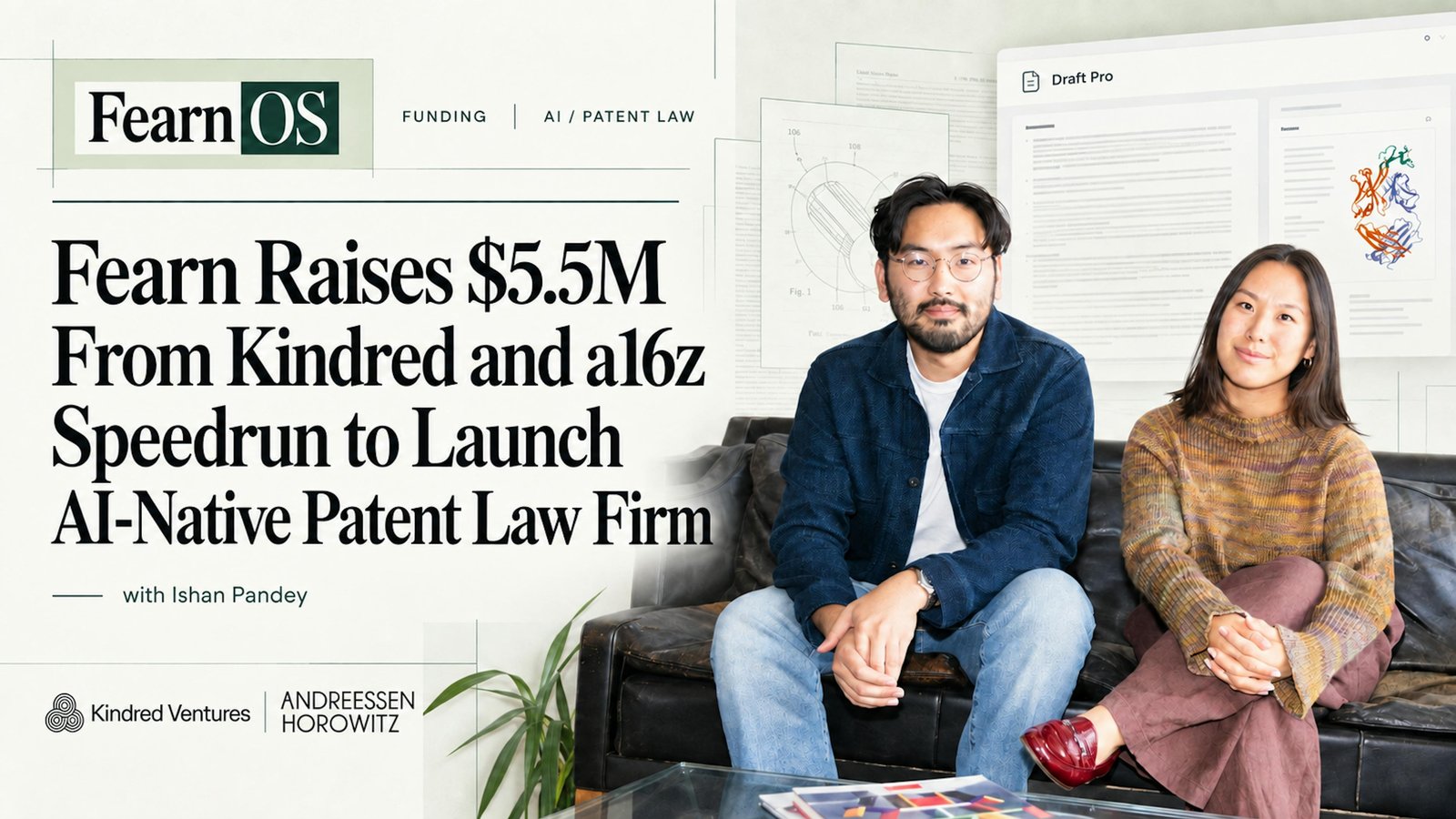
On September 23, 2026, Fearn formally launched as the latest entrant in the growing field of NewMod, or new model, law firms, AI-native legal practices built from the ground up around artificial intelligence rather than retrofitting technology into traditional law firm structures. The firm, which raised $5.5 million in seed funding from investors including Kindred Ventures and a16z Speedrun earlier this summer, was founded by Han Kim, previously an attorney at Morrison & Foerster, and Angela Gao, who holds a PhD in computer science and artificial intelligence. Fearn focuses on patent prosecution for technology startups, combining patent experts and PhDs with proprietary models purpose-built for patent law, and promises to take a founder from explaining an invention to a review-ready patent application in hours rather than the months that conventional practice requires. For personal injury law firms, the Fearn launch is significant not because patent prosecution overlaps with personal injury practice but because it demonstrates how AI-native business models are redefining what clients expect from legal services in every practice area, and because the same technological and economic forces that enable Fearn to deliver patent applications in hours with fixed fees will inevitably reshape client expectations for speed, cost, and transparency in personal injury representation as well.
The business model that Fearn has constructed is deliberately designed to invert the economics of traditional patent practice. A conventional patent application, the firm notes, typically requires 30 to 40 hours of attorney time and costs between $18,000 and $40,000 in legal fees, while startups wait months to protect technology that can change by the day. Fearn offers provisional filings in as little as three business days, fixed fees that the firm claims are far lower than market rates, and a guarantee that puts its drafting fee at risk if a non-provisional application receives no allowed claims. The firm drafts and prosecutes patents across software, hardware, robotics, semiconductors, defense, biotech, and pharma, and uses a proprietary drafting and client management system that represents a patent as a graph mapping claims to supporting text, figures, and technical material behind them, while preserving attorney edits and a full record of how each section was produced. This system architecture, which treats the patent document as a structured data object rather than a linear text file, is emblematic of how AI-native firms are reimagining legal workflows from the database layer upward.
The competitive implications for the broader legal market are substantial. Fearn joins a rapidly expanding cohort of NewMod firms that includes Crosby for contract review, Vetta for private capital, Garfield AI as the first AI-powered firm authorized by the UK's Solicitors Regulation Authority, and Avantia Law, which has eliminated billable hours in favor of fixed-price services. While each of these firms is currently small relative to the Am Law 200, the model they are pioneering, combining proprietary AI technology with lean legal expertise, fixed fees, and rapid turnaround, is precisely the model that corporate clients and individual consumers are increasingly demanding across all practice areas. A 2026 Thomson Reuters Future of Professionals report found that 32% of in-house legal professionals are reconsidering their relationships with law firms that fail to demonstrate clear AI-enabled value. The percentage of individual clients who will make similar assessments of their personal injury counsel is likely to grow as AI-native firms in adjacent practice areas demonstrate what is possible when technology is central to the business model rather than peripheral to it.
The technical and ethical dimensions of the NewMod model also carry lessons for personal injury practice. Fearn's proprietary models, which are purpose-built for patent law rather than general-purpose models adapted to legal work, suggest that the most effective AI applications in legal practice will be those trained on domain-specific data, structured around domain-specific workflows, and integrated with domain-specific quality control mechanisms. For PI firms, this means that the generic AI tools marketed to the legal industry, contract analyzers repurposed for demand letters, general-purpose summarizers applied to medical records, may be less effective than tools specifically designed for the PI workflow: intake triage, medical record chronology, damages calculation, discovery management, and settlement analysis. Fearn's performance guarantee, which puts the firm's fee at risk if the work product fails to meet a defined standard, is also a model that PI firms should consider, because it aligns the firm's economic interests with the client's outcome in a way that hourly billing never can, and because it forces the firm to build quality control and risk assessment into its AI systems from the outset rather than treating errors as acceptable costs of experimentation.
For personal injury law firm leadership, the Fearn NewMod launch carries three practical implications. First, the emergence of AI-native law firms with proprietary models, fixed fees, and performance guarantees in adjacent practice areas demonstrates that client expectations for legal service delivery are being reset by technology, and PI firms should evaluate whether their own pricing structures, turnaround times, and technology infrastructure meet the standards that clients are increasingly exposed to through NewMod firms in other practice areas, because clients who experience rapid, fixed-fee, technology-enabled legal services in one domain will bring those expectations to every legal interaction they have. Second, Fearn's graph-based patent representation system illustrates how AI-native firms are rethinking the fundamental data structures of legal practice, and PI firms should assess whether their own document management, case management, and workflow systems are built on linear, paper-based metaphors or on structured, queryable data models that can support AI-powered analysis, automation, and reporting, because the firms that build their technology infrastructure on modern data architectures will be able to deploy AI capabilities faster and more effectively than firms that are constrained by legacy systems. Third, the rapid proliferation of NewMod firms, from Crosby and Vetta to Fearn and beyond, signals that the competitive threat from AI-native competitors is not a distant theoretical possibility but an active market reality, and PI firms should begin developing their own AI-native capabilities, whether through proprietary development, vendor partnerships, or strategic investments, because the window for traditional firms to adapt before AI-native competitors capture meaningful market share is closing faster than many firm leaders appreciate. As Fearn and its NewMod peers demonstrate that AI-native legal practice is not only possible but commercially viable, the launch is a reminder that the transformation of legal service delivery through artificial intelligence is accelerating across every practice area, and the firms that build their operations around AI from the ground up, rather than layering it on top of traditional structures, will be the firms that define the next generation of legal practice.