Beginner
Prompting

Prompt Engineering Fundamentals

60 minutes5 steps

Master the art of writing effective prompts that get consistently great results from any AI model. This lesson teaches the core principles of prompt engineering with practical examples for legal professionals.

Progress0/5 steps (0%)

Step 1: Why Prompting Matters

The difference between a useless AI response and a brilliant one often comes down to HOW you ask. A vague prompt like 'Write about car accidents' gives generic content. A specific prompt like 'Draft a demand letter introduction for a rear-end collision case where my client suffered a herniated disc at L4-L5, the defendant ran a red light, and there are two witnesses' produces highly targeted, actionable output. Prompt engineering is the skill of communicating precisely with AI to get the results you need.

Step 2: The CRAFT Framework

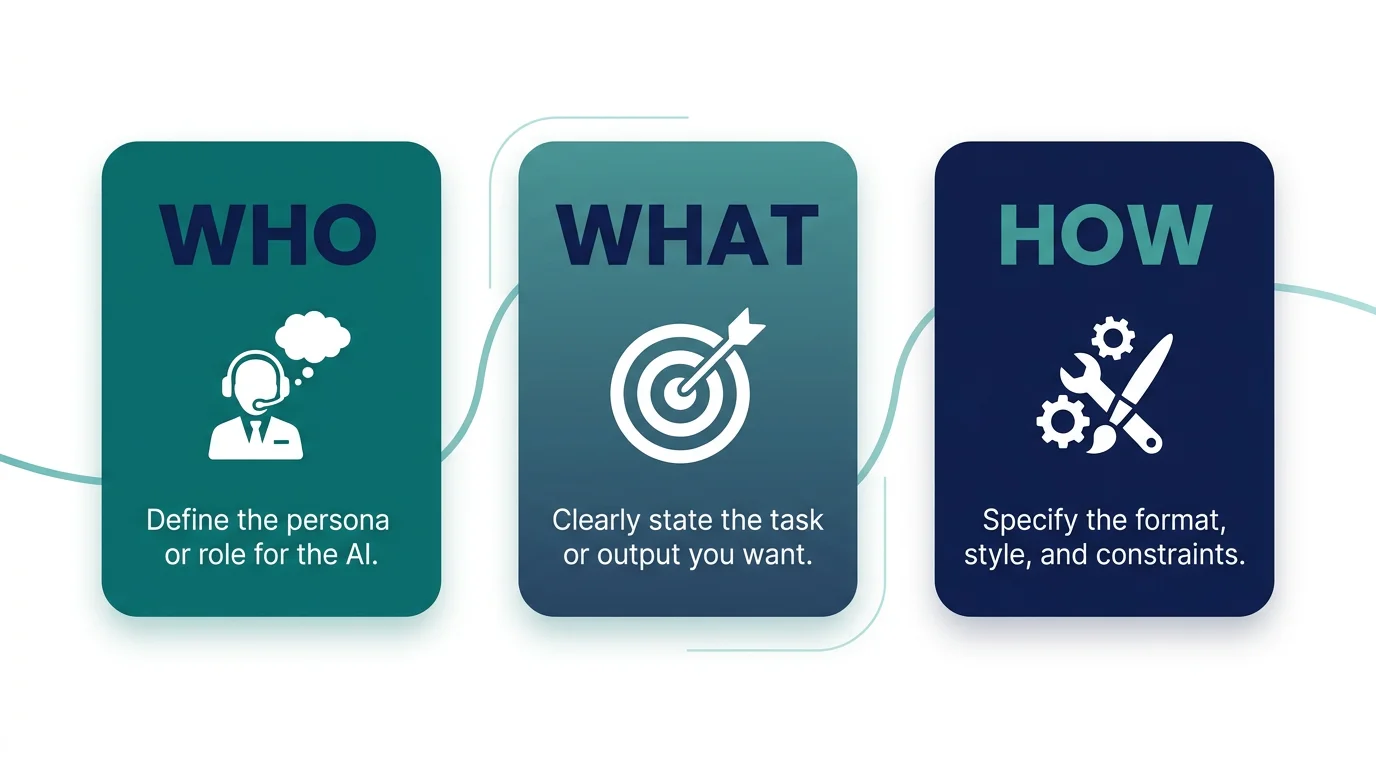
Use the CRAFT framework for consistent results: Context (set the scene — 'You are a personal injury attorney in California'), Role (define who the AI should be — 'Act as an expert demand letter writer'), Action (what to do — 'Draft a liability analysis section'), Format (how to structure output — 'Use numbered paragraphs with legal citations'), and Tone (communication style — 'Formal and persuasive, suitable for insurance adjusters'). Applying all five elements dramatically improves output quality.

Step 3: Being Specific and Structured

Vague inputs produce vague outputs. Always include: specific facts and details relevant to your task, clear constraints ('Keep it under 500 words', 'Focus only on liability'), desired output structure ('Create a table with columns for...', 'List in order of importance'), and examples of what good output looks like. For legal work, include case details, jurisdiction, applicable statutes, and the specific legal standard you're working with. The more context you provide, the less the AI needs to guess.

Step 4: Iterative Refinement

Great prompts rarely happen on the first try. Use iterative refinement: start with your best prompt, review the output critically, identify what's missing or wrong, and modify your prompt to address those gaps. Common refinements include: 'Be more specific about damages calculations', 'Include case law citations from the last 5 years', 'Make the tone more aggressive', or 'Add a section about comparative negligence'. Think of each iteration as coaching the AI to do better.

Step 5: Building a Prompt Library

Create reusable prompt templates for common tasks: demand letter sections, discovery response drafts, deposition question lists, case summaries, client communication templates, and settlement analysis frameworks. Store these in a shared document or tool like Notion. Include placeholders for case-specific details [CLIENT_NAME], [INCIDENT_DATE], [INJURIES]. A good prompt library saves hours and ensures consistent quality across your practice.

Key Takeaways

The quality of AI output is directly proportional to the quality of your prompt.
Use the CRAFT framework: Context, Role, Action, Format, Tone.
Be as specific as possible — include facts, constraints, and examples.
Iterate and refine — great prompts develop through testing.
Build a reusable prompt library for your most common tasks.

Related Tools

ChatGPT
Claude AI
Google Gemini
Perplexity AI

Video Resources

Prompt Engineering Tutorial – Master ChatGPT and LLM Responses

Comprehensive tutorial on mastering prompt engineering to optimize ChatGPT and other LLM responses.
Prompt Engineering 101 - Crash Course & Tips

Beginner-friendly crash course covering the fundamentals of prompt engineering with practical tips.

Prompt Engineering Guide - From Beginner to Advanced

Complete guide from beginner to advanced including zero-shot, few-shot, and Chain-of-Thought techniques.